

Verification Incentive Program Tracks
-
Food Hub Ready Verified
Get ready and prepared to access larger institutional markets by meeting requirements to sell to your local Food Hub. Get support completing documentation to help level up your farm, plus two years of access to a farmer-friendly platform for verification and traceability.
Earn a $2,500 annual stipend (up to two years) upon completion.
-
Regenerative Verified
Access funding to implement regenerative practices that strengthen your soil and farm resilience.
Receive up to $10,000 per year (for up to two years) to support practices like compost application, reduced or no-till (including equipment), high tunnels, and cover cropping, helping you invest in long-term productivity and thriving on-farm performance.
-
Food Safe Verified
(COMING SOON)
Advance your farm’s food safety readiness to achieve SAFE verification and prepare for future Group GAP eligibility. This track supports required steps including a recent food safety training certificate, up to $28,000 for a FSMA-compliant wash station upgrade, and active use of the Heavy Connect platform, positioning your farm for expanded market access.
Congratulations on joining our Incentive Program, and welcome to the AMP Program Page. Along with your Heavy Connect account, this will be your hub for program resources. Here you’ll find FAQs, NRCS documentation, conservation practice standards, provider links, and companion materials to help you successfully implement practices and complete program requirements for the 3 program tracks. This page will continue to grow and be updated with new resources over the next two years as the program evolves.
Food Hub Ready Verified
Through this program, farmers will complete and upload the standard documentation required by food hubs in order to access more stringent food safety markets. Participants will receive two years of access to Heavy Connect, a platform that supports food safety practices, verification, and traceability, along with a $2,500 annual stipend (for up to two years) upon completion of required documentation.
Moving forward, this documentation will be required to sell in most markets through Foodshed. Food Hub Ready is designed to compensate farmers in order to make that transition achievable.
Resources:
Phase 1:
Heavy Connect Platform - we will send you the login credentials for your account via email.
From your laptop, use the HC Dashboard: dashboard.heavyconnect.com
Phase 2
Find out which FSMA category you are in:
https://caff.org/wp-content/uploads/2017/08/Does-FSMA-Apply-to-Your-Farm.pdf
All farms are required to submit an annual water test; use the resources below based on the type of water you use for post-harvesting wash (croplands) or irrigation water source for orchards.
Pre-Harvest Agricultural Water (Irrigation/Growing)
For covered produce other than sprouts, the FDA replaced mandatory routine microbial testing with a systems-based agricultural water assessment approach.
Assessment Requirement: Farms must conduct a written assessment annually (or after significant changes) evaluating the water system, practices, crop characteristics, environmental conditions, and adjacent/nearby land uses to identify hazards.
Testing: Routine testing is not universally required for pre-harvest water. However, testing for generic E. coli is required if the assessment identifies known or reasonably foreseeable hazards (e.g., animal activity, untreated human waste) where mitigation is necessary, and testing would inform the determination of necessary measures.
Exemptions: Farms are exempt from conducting this assessment if their pre-harvest water:
Meets the microbial quality standards for harvest/post-harvest water (see below).
Comes from a public water system that complies with the rule.
Is treated according to FSMA standards.
Harvest and Post-Harvest Agricultural Water
For water used during harvesting, packing, or holding (e.g., washing, cooling, hand-washing), strict microbial quality standards and testing apply to all covered produce.
Microbial Quality Criterion: Water must have < 0 MPN generic E. coli per 100 mL (no detectable generic E. coli).
Testing Requirement: Farms must test water quality using a scientifically valid method equivalent to EPA Method 1603 (or similar).
Untreated Groundwater: If using untreated groundwater for these activities, farms must conduct initial and ongoing testing to establish a microbial profile and ensure it meets the quality criterion.
Untreated Surface Water: The use of untreated surface water for harvest/post-harvest activities is prohibited.
Management: Non-single-pass water (recirculated/reused) must be managed with water change schedules and visual monitoring to prevent contamination buildup.
Water testing
Look up water testing labs near you on the map: https://waterboards.maps.arcgis.com/apps/webappviewer/index.html?id=bd0bd8b42b1944058244337bd2a4ebfa
Identify your water source:
Wells:
The State of California does not regulate water quality in private domestic wells. DDW (Division of Drinking Water) regulates the water quality in public water systems
Some hardware stores have at-home water quality testing kits available
The water board recommends testing annually for
Total coliform bacteria, Nitrate, and Electric conductivity (EC) (which is also an indicator of salinity)
Sampling costs: Basic sampling ranges from $100-400 (depending on the number of constituents analyzed)
Well Water Information Based on Where You Live (United States Environmental Protection Agency)
State Certified Drinking Water Laboratories (United States Environmental Protection Agency)
Municipal Water
www.usgs.gov/faqs/where-can-i-find-information-about-my-local-drinking-water-supply
Annual drinking water quality report/consumer confidence report that water suppliers now send out by July 1 of each year. Reports are often sent out with water bills.
The reports tell where drinking water comes from, what contaminants it contains, and at what levels.
Many water suppliers have their water quality reports accessible on the EPA site: www.epa.gov/ground-water-and-drinking-water/drinking-water-data-and-reports
Collected Rainwater
Testing and Applying Harvested Water to Irrigate a Vegetable Garden
A 55-gallon rain barrel should be cleaned with a 3% bleach solution before collecting water for vegetable irrigation (5-6% chlorine solution added at a rate of 1/8 teaspoon (8 drops) of bleach per gallon of water.
Roof runoff can have high levels of pathogens, zinc (Zn), lead (Pb), and polycyclic aromatic hydrocarbons (PAHs)
Harvested rainwater should only be applied to the soil, possibly through drip irrigation in the morning only, avoid getting water on the plant itself.
At a minimum, E. coli testing should be conducted.
Local Water Testing Labs:
Alpha Analytical Lab - www.alpha-labs.com - San Diego - ELAP #3055 - 980 Park Center Drive, Ste C - Vista, CA 92081 - Phone: 760.536.3352
Other Resources:
Food Safety Plan:
Start with the Produce Safety Grower Training, either if its time to renew your certificate or get it for the first time, this course helps you keep food safe, stay compliant, and protect your farm’s markets. This virtual training will help you learn about food safety standards and answer any questions you have. You will receive a book for future reference that will help you create a food safety plan.
CDFA Produce Safety Grower Training course - Register for a training through UC Cooperative Extension.
CAFF Food Safety Resources: https://caff.org/organic-certification/food-safety-plan-templates/
National Young Farmers Coalition: A small farmer’s practical guide to food safety
FAQ
-
Please submit all required documentation via email for Phase 1 documentation.
For Phase 2 documentation you will receive resources and access to use HeavyConnect, a simple app you can use right from your phone or your laptop to log activities, upload photos and receipts, and check-ins. -
An account for your farm will be created and we’ll send you login instructions. From your laptop, use the HC Dashboard: dashboard.heavyconnect.com
For the mobile app, Download app HC 2.0
Apple: https://apps.apple.com/us/app/heavyconnect-2-0/id1571813057
Android: https://play.google.com/store/apps/details?id=com.heavyconnect.android&hl=en_US&pli=1
-
A Food Safety Plan documents how you prevent contamination risks on your farm. Your plan should cover water quality, compost sourcing, worker hygiene, equipment sanitation, and pest management.
We provide a basic template you can customize for your operation. Once completed, you’ll have access to Heavy Connect, our reporting and verification platform.
-
The main focus of water testing is checking for microbial contamination, particularly generic E. coli and other harmful pathogens. You must test irrigation and other water that contacts your produce for microbial contamination. The requirement applies to cropland producers with irrigation from wells, ponds, or streams, and to orchard producers using overhead irrigation. If you use drip irrigation under plastic on tree crops like citrus or avocados where water doesn't reach the fruit, testing may not be required.
-
For the first year of participation, the first $1000 will be awarded once we receive (via Heavy Connect):
Copy of a Certificate of Liability Insurance with Foodshed as an additional insured
W9
A signed copy of our Vendor Handbook
FSA ID # from the USDA (only required to receive incentive payments)
The remaining $1500 will be awarded when we receive:
A basic Food Safety Plan
Recent water testing results
Regenerative Verified

Improve on-farm resilience through the adoption of NRCS Conservation (Regenerative) Practices and translate outcomes to enhanced market opportunities. This track allows commercial land-based farms (minimum ½ acre in production) in San Diego and Riverside Counties to access funding for implementing regenerative practices that strengthen soil health and farm resilience!
Resources:
Compost Application
NRCS Compost Application (CPS 808) supports soil health by applying stabilized organic compost to improve soil structure, water holding capacity, and biological activity. Compost must meet quality standards for maturity and contaminants and be applied at agronomic rates based on crop needs and site conditions. Applications should avoid runoff risks and protect water quality.
Typical eligible features include:
Stabilized plant- or manure-based compost
Lab analysis provided by the compost producer
Application rates based on soil/crop recommendations
Uniform field application
Documentation of compost source and volume
Timing and placement that minimize runoff and erosion
Practice Standard: Soil Carbon Amendments (CDFA CPS 808)
Facilities:
San Diego
San Pasqual Valley Soils - Escondido - www.spvsoils.com - (760) 746-4769
Mountain Meadow Mushrooms - Escondido - mmmushroom.com - (760) 749-1201
Agriservices WM - Oceanside & Otay Mesa - (760) 295-6255 - www.agriserviceinc.com
EB Living Earth and Materials - Ramona - (760) 801-5664
Riverside
SA Organics Recycling - Thousand Palms - www.sarecyclingorganics.com - (760) 343-0499
Soil Direct www.soildirect.com
Campos Materials - camposmaterials.com
EarthWorks Soil Amendments - Riverside - www.ewsa.com - (951) 782-0260
No till / Reduced tillage
NRCS No-Till (CPS 329) minimizes soil disturbance by limiting tillage during crop establishment and production. The goal is to maintain crop residue on the soil surface, reduce erosion, improve soil biology, and increase water infiltration. Soil disturbance should be limited to narrow seed slots or planting rows only.
Typical eligible features include:
Direct seeding with minimal soil disturbance
Residue is maintained across the soil surface
Specialized no-till planting equipment
Reduced erosion and improved moisture retention
No full-width tillage operations
Reduced tillage (CPS 345) reduces tillage intensity and frequency while maintaining protective crop residue on the soil surface. This practice helps improve soil structure, reduce compaction, and lower erosion while allowing flexibility for field preparation and planting.
Typical eligible features include:
Fewer tillage passes
Reduced soil disturbance depth/intensity
Crop residue retention after planting
Use of conservation tillage equipment
Improved soil moisture and reduced erosion
Practice Standards: No Till (CPS 329) - Reduced Tillage (CPS 345)
Tools/Equipment: BCS America - Equipment in use Video
Photos: BCS with attachment - BCS mowing
High Tunnels
NRCS High Tunnel Systems (CPS 325) are designed to extend the growing season, protect crops from weather impacts, and improve soil and plant health. Eligible structures must be manufactured kits (not DIY), covered with greenhouse-grade UV-resistant plastic, and have a minimum peak height of 6 feet. Crops must be grown directly in the natural soil profile or raised beds no deeper than 12 inches—hydroponics, benches, and container production are not eligible. Structures must include end walls, be located on well-drained sites with a slope of less than 5%, and be used for crop production only (not for storage or livestock).
Typical eligible features include:
Metal, wood, or durable plastic frame
Minimum 6-ft peak height
6-mil UV-resistant greenhouse plastic covering
Roll-up sides and ventilation systems
In-ground crop production only
Access to an irrigation water source
Practice Standard: High Tunnels (CPS 325)
Providers: www.farmersfriend.com
Cover Crop
NRCS Cover Crops (CPS 340) are planted to protect and improve soil between cash crop cycles. Cover crops help reduce erosion, suppress weeds, improve soil biology, increase organic matter, and enhance nutrient cycling. Species selection should match climate, soil conditions, and management goals.
Typical eligible features include:
Seasonal planting of grasses, legumes, or mixed species
Soil coverage during fallow periods
Biomass production for soil protection
Weed suppression and erosion control
Improved soil organic matter and water infiltration
Practice Standard: Cover Crop (CPS 340)
NRCS eVegGuide - Calflora (sign in required)
Seeds/Mix Vendors:
Local Vendors: Ernie Klemm Farm Services custom seed mixes (grasses, legumes, grains, pollinator, etc.) with or without inoculation. Green Manure. Seeding equipment services available. klemmranch1@gmail.com
California-based / West-Coast suppliers (Organic-compatible Vendors):
S&S Seeds – www.ssseeds.com (Strong catalog for CA dryland clovers and vetch)
Hedgerow Farms – www.hedgerowfarms.com (Native & naturalized clovers suitable for foothills)
Peaceful Valley / GrowOrganic – www.groworganic.com (Wide range of organic cover crop seeds; good pricing)
Green Cover Seeds – www.greencover.com (Excellent multi-species mixes; can custom blend)
Other vendors:
Johnny’s Selected Seeds - www.johnnyseeds.com/farm-seed/cover-crop-mixes (Precombined cover crop seed mixtures for both spring and fall planting. These mixes can be used as a green manure incorporated into the soil or to provide winter erosion control)

FAQ
-
Funding for this program includes incentives for the implementation of the following practices:
Compost (CPS 336/CDFA CPS 808)
No till / Reduced tillage (CPS 329 & 345)
High Tunnels (CPS 325)
Cover Cropping (CPS 340)
-
NRCS Conservation Practice Standards are documents that define the minimum technical criteria required to plan, design, install, operate, and maintain conservation practices to ensure they achieve their intended natural resource benefits. These standards cover a wide range of activities, including irrigation water management, heavy use area protection, composting facilities, and nutrient management, addressing concerns related to soil, water, air, plants, animals, and energy.
-
You can read the specs for each practice at the USDA website (open links below by clicking on the practice name).
Once enrolled in the program, access to these documents will be available through Heavy Connect.
-
Compost can be purchased from any local compost facility that has the US Composting Council's Seal of Testing Assurance Program (STA) or use an alternative NRCS- or State-approved certification program that considers laboratory performance and proficiency.
A lab test provided by the Compost facility is required for this program.
In California, while compost operations do not need to meet NRCS practice standards, composting activities are primarily regulated by CalRecycle, the State Water Resources Control Board, and local Air Districts. CA
The key point is that NRCS focuses on the quality of the finished compost product (testing assurance, carbon-to-nitrogen ratios, contaminant levels) rather than on certifying the facilities themselves.
-
To calculate compost volume in cropland or orchard you can use the compost calculator here.
-
A lab test (provided by the facility) of the compost blend you’ll be using is a requirement for this incentive if your field is involved. The lab analysis confirms your compost is safe and suitable for food crop production. The analysis tests for pathogens, heavy metals, and contaminants that could harm your crops or consumers. Under FDA FSMA and NRCS standards, compost must meet quality criteria verified by the US Composting Council's Seal of Testing Assurance Program or equivalent certification. The analysis also shows carbon-to-nitrogen ratios and nutrient content, helping you apply compost at the right rate for your soil and crops. Without verification, you cannot document that your compost source meets food safety requirements.
-
To support your success, we offer optional office hours where you can ask questions and troubleshoot challenges. For soil testing, you have the option to drop off samples at our facility, we can provide standard guidance on how to perform the soil sampling yourself. These resources are designed to make implementing NRCS practices straightforward and achievable.
We've built Conservation Practice Standard (CPS) modules directly into Heavy Connect to guide you through reporting practices implementation. -
EE CPA-52 is USDA's Environmental Evaluation requirement that assesses environmental impacts of your farming operation, including soil health, water quality, and pest management practices. It's required under the Advancing Markets for Producers (AMP) program to ensure your operation meets environmental stewardship standards and qualifies for program benefits and incentives.
We’ll work together to gather all necessary info and sending it for review and approval to the NRCS to get all enrolled farms a fast turnaround for this required documentation. -
Participants will receive two years of access to Heavy Connect, a platform that supports food safety practices, verification, and traceability. When implementing practices you will be able to upload documentation required to the HC dashboard. We will provide you with tutorials and NRCS CPS modules to follow practices standards.
-
An account for your farm will be created and we’ll send you login instructions. From you laptop, use the HC Dashboard: dashboard.heavyconnect.com
For the mobile app, Download app HC 2.0
Apple: https://apps.apple.com/us/app/heavyconnect-2-0/id1571813057
Android: https://play.google.com/store/apps/details?id=com.heavyconnect.android&hl=en_US&pli=1
-
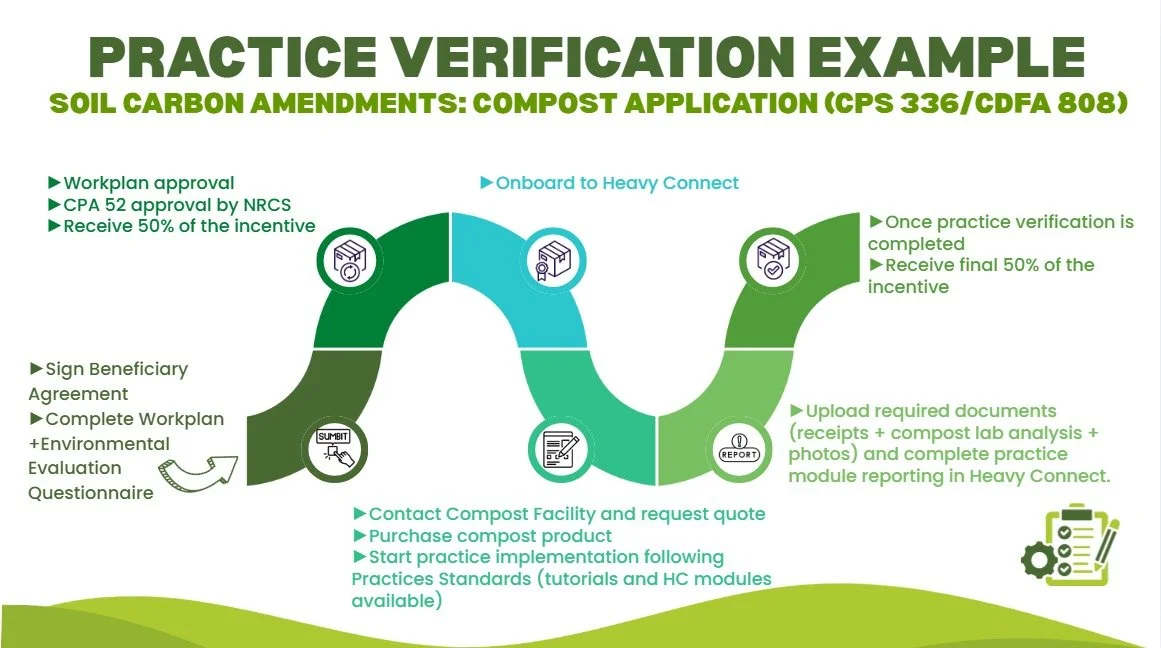
Once farm is enrolled by signing the Beneficiary Agreement and onboarded into Heavy Connect, participants will receive 50% (or $5k) paid to farmer for all practices except equipment and high tunnels, which we can pay 80% upfront to help cover the cost.
If paying for equipment, you can request the full $20k in year 1, but would still need 2 years of reporting.
Once farmer uploads photos / receipts to Heavy Connect to verify practice you’ll receive the remaining $$ paid to farmer once verification is receivedInvoicing and payments are processed via Ramp app.
Payment can be expected to take approximately 30 - 45 days.
(COMING SOON)
Advance your farm’s food safety readiness to achieve SAFE verification and prepare for future Group GAP eligibility. This track will support up to 20 commercial farmers in San Diego and Riverside Counties on required steps, including a recent food safety training certificate, an FSMA-compliant wash station upgrade plan (up to $28,000), and active use of the Heavy Connect platform, positioning your farm for expanded market access.